
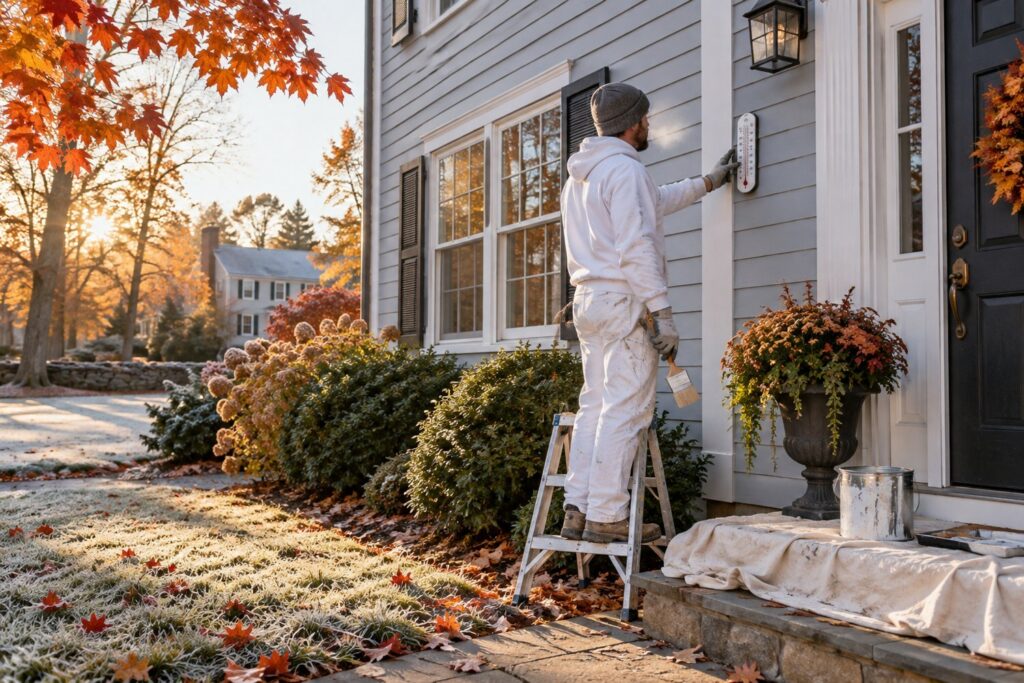
How Cold Is Too Cold? When an Exterior Home Painting Company Stops for the Season
Short answer: Most modern exterior latex paints can go on when the air and the surface are at least 35°F. Older and budget paints often need 50°F. But the number on the can is only part of it. The temperature has to stay above that minimum for hours after painting (some makers ask for a full day or two), the surface has to be dry and at least 5°F above the dew point, and no rain or frost can arrive before the paint sets. In Lower Bucks County those conditions get unreliable once October ends, which is why a careful exterior home painting company winds down outside work for the season around then.
If you’re hoping to get the house painted before winter, this guide explains what “too cold” really means, why nights matter more than afternoons, what cold-weather painting problems look like, and what to do if your project misses the window.
Why cold weather matters for exterior paint
Latex paint isn’t just colour that dries. As the water evaporates, tiny plastic particles in the paint have to soften and fuse into one continuous film. That film is what sheds rain, resists UV and stretches as your siding moves.
When it’s too cold, those particles don’t fuse properly. The paint may look fine the next morning, but the film underneath is weaker. It can crack, chalk early, wash out in streaks or lose its grip on the wood. You often don’t see the damage until the following spring or summer, long after the crew has left.
Cold also slows everything down. Sherwin-Williams’ data sheet for Resilience exterior paint, for example, lists a recoat time of 4 hours at 45°F and above, but 24 to 48 hours between 35°F and 45°F. On a short November day, that can mean one coat per day at best.
The minimum temperature, by type of paint
Here’s what the major brands sold in Bucks County say on their own product data sheets. Always check the label for the exact product, because lines within one brand differ.
Paint type | Lowest air and surface temperature | What the maker adds |
|---|---|---|
Standard exterior latex (many older or budget lines) | 50°F | Should stay above 50°F for at least 8 hours after painting (Diamond Vogel guidance) |
Sherwin-Williams Duration, SuperPaint, Resilience | 35°F | Air, surface and the paint itself above 35°F; no rain or snow expected within 2 to 3 hours |
Benjamin Moore Aura exterior | 35°F | Do not apply below 35°F |
Benjamin Moore Regal Select exterior | 40°F (low-temperature formula) | Do not apply below 35°F |
Behr Marquee exterior | 35°F to 90°F | Must stay in that range for at least 4 hours after applying |
Two things stand out. First, “low-temperature” paints really have changed the game. Sherwin-Williams’ own FAQ notes that until a few years ago most painting had to happen above 50°F. Second, every one of these limits applies to the surface as well as the air, and the surface is usually colder.
Why the overnight low matters more than the afternoon high
A 55°F afternoon in late October feels like perfect painting weather. The problem is what happens after the crew packs up.
Paint applied at 2 pm is still curing at 2 am. If the temperature drops below the product’s minimum overnight, the film forms in the cold even though it went on in the warmth. That’s why manufacturers talk about how long the temperature must hold, not just what it is at the moment of painting. Behr asks for at least 4 hours. Diamond Vogel asks for 24 hours at 35°F or more for its low-temperature paints.
Here are the 30-year averages for Levittown (NOAA 1991 to 2020 normals):
Month | Average high | Average low | What it means for exterior painting |
|---|---|---|---|
September | 79°F | 57°F | Prime time: warm days, mild nights |
October | 67°F | 46°F | Still good, but nights cool fast late in the month |
November | 56°F | 36°F | Average lows near the 35°F floor; frost and dew are common |
December | 46°F | 29°F | Below the minimum for every product above |
Those are averages, so plenty of November nights are colder than 36°F. By early November, a typical night in Lower Bucks sits right at the limit of even the best low-temperature paints. That’s the real reason exterior work here generally stops at the end of October.
Dew, frost and short days: the hidden problems
Temperature isn’t the only thing that changes in autumn.
- Dew point. Paint makers, including Sherwin-Williams, ask that the surface be at least 5°F above the dew point. Cool autumn nights mean heavy dew, and siding can stay damp until late morning. Painting over a damp surface traps moisture under the film.
- Surfactant leaching. When latex paint gets wet with dew or drizzle before it has cured, soap-like ingredients can rise to the surface. You see sticky, brown or white streaks running down the siding. They usually wash off, but they’re a sign the paint didn’t have the conditions it needed.
- Short working days. In late October and November, a crew might only have a few hours between the dew drying off and the temperature dropping again. That means fewer coats per day and a longer job.
- Shade and sun. North-facing walls in the shade stay colder and damper than a south wall in the sun, as Sherwin-Williams warns on its data sheets (“substrates may be colder” than the air). A crew that paints the cold side first thing in the morning is asking for trouble.
- Rain and frost. Sherwin-Williams asks that no rain or snow be expected for 2 to 3 hours after painting. Frost on fresh paint does similar damage to rain.
What cold-weather paint failure looks like
If a house was painted when it was too cold, here’s what you might notice over the following months:
What you see | What likely happened |
|---|---|
Fine cracks across the paint (like dried mud) | The film didn’t fuse properly in the cold |
Brown, white or sticky streaks after the first rain or dew | Surfactant leaching from paint that got wet before it cured |
Patchy sheen or uneven colour | Uneven drying across warm and cold walls |
Paint peeling from wood within a year | Poor adhesion from cold or damp surfaces |
Early chalking or fading | A weaker film that breaks down faster in the sun |
Some of these, like leaching, clean up easily. Others, like cracking and peeling, mean scraping and repainting sooner than you should have to. The cost of waiting until spring is a few months. The cost of painting in the wrong conditions can be years of the paint’s life.
How a professional exterior home painting company decides it’s too cold
Good crews don’t just check the weather app in the morning. Before any exterior work in autumn, a careful painter looks at:
- The overnight forecast, not just the daytime high, for every day of the job.
- The paint’s data sheet for the minimum temperature and how long it must hold.
- The surface temperature, often with an infrared thermometer, especially on shaded walls.
- The dew point and humidity, so painting starts after surfaces are dry and stops early enough for the paint to set before evening dew.
- Rain and frost risk in the hours after painting.
- The job size. A single door or a set of shutters can fit into one good afternoon. A whole house with scraping, repairs, primer and two coats needs several good days in a row.
If the forecast can’t support the full job, the honest answer is to wait. You might be able to get away with a small touch-up in November. A full exterior is a different story.
As your exterior home painting company in Bucks County, we use quality products from Sherwin-Williams, Behr and Benjamin Moore, and we plan exterior work around the weather rather than squeezing it in.
Missed the window? What to do this winter
If your exterior didn’t get done this year, you haven’t lost anything by planning ahead. Here’s how to use the cold months:
- Get your quote now. At New Look, work usually starts one to three months after the quote, once colours and specifications are confirmed. A quote this winter puts you near the front of the line for spring.
- Choose colours in daylight. Winter is a calm time to test samples on the house and see them in real light.
- Fix small problems before they grow. Re-caulking a gap or covering a bare patch of wood (if the weather allows) can stop water getting in until spring.
- Do the inside instead. Interior painting has no season, and winter is a great time for it. Crews have more availability, and modern low-VOC paints make it comfortable to stay at home while the work happens. See our interior painting services.
- Think about the timeline. If you’re not sure the house needs painting yet, our guide on how often to paint your house walks through the signs and the typical lifespan of each surface.
In our area, exterior painting usually picks up again from late April, once nights stay reliably mild.
Signs your exterior can wait until spring, and signs it can’t
Most houses can wait a few months without harm. A few situations call for a quick fix before winter, even if the full paint job waits.
Usually fine to wait until spring:
- Fading or a chalky film when you rub the siding
- Minor scuffs and dirt
- Colour you’re just tired of
Worth a small repair before winter:
- Bare wood showing on trim, sills or the bottom of doors
- Open gaps where caulk has failed around windows and doors
- Peeling paint where water can get behind it
For these, ask a contractor about a targeted repair on a mild, dry day, then plan the full exterior for spring. Our exterior house painting services guide explains what a full job includes, from prep to the final walkthrough.
Plan your spring exterior with New Look
We’re a locally owned painting and remodeling company based in Levittown, and we paint homes across Bucks County, including Bensalem, Langhorne, Newtown, Yardley and Southampton. Every job starts with an on-site visit and a printed quote that lists labour, materials, pricing and work specifications, so you know what’s included before anything starts.
If you want your house painted as soon as the weather allows, the best time to talk to us is now. Call 267-980-1476, email info@newlookpainting.org or request a free quote. You can also browse finished projects in our gallery or see our full service areas.
Frequently asked questions
How cold is too cold to paint outside?
For most modern exterior latex paints, the air and surface need to be at least 35°F. Older or budget paints often need 50°F. The temperature also has to stay above the minimum for several hours after painting, and some makers ask for 24 hours or more.
Can you paint a house exterior in November in Pennsylvania?
Sometimes, for small jobs on a mild, dry stretch. In Levittown, the average November low is about 36°F, right at the limit of even low-temperature paints, and dew and frost are common. A full exterior with prep and two coats is usually better scheduled for spring.
Does the temperature need to stay up overnight after painting?
Yes. Paint keeps curing for hours after it goes on. Behr asks for its Marquee exterior paint to stay between 35°F and 90°F for at least 4 hours after applying, and Diamond Vogel asks for 24 hours at 35°F or more for its low-temperature paints.
What happens if exterior paint freezes before it cures?
The film may not form properly. You could see cracking, poor adhesion, uneven sheen or peeling, sometimes not until months later. Repainting is often the only fix.
What is surfactant leaching?
It’s when dew or light rain hits latex paint before it has cured, drawing soap-like ingredients to the surface. It shows up as sticky, brown or white streaks. It usually washes off with water, but it’s a sign the paint went on in damp or cold conditions.
Is surface temperature different from air temperature?
Yes. Siding in the shade, especially on north-facing walls, can be noticeably colder than the air. Paint makers set their minimums for both the air and the surface, so a careful painter checks the surface, not just the forecast.
What is the dew point rule for painting?
Manufacturers such as Sherwin-Williams ask that the surface be at least 5°F above the dew point. Below that, moisture can form on the surface and get trapped under the paint.
When does the exterior painting season start again in Bucks County?
Generally from late April, once nights stay reliably above the paint’s minimum. Late spring and early autumn are the best parts of the season.
Is it a good idea to book a spring exterior job in winter?
Yes. At New Look, work usually starts one to three months after the quote. Getting your quote in winter means colours and specifications are ready when the weather turns.
Can you paint the inside of a house in winter?
Yes. Interior painting has no season, and winter is a good time for it. Modern low-VOC paints make it comfortable to stay at home while the work is done.
Do low-temperature paints last as long as regular paints?
They’re made to be applied in cooler weather, as long as you stay within the conditions on the label. Most problems come from painting below the minimum, or from dew, rain or frost arriving before the paint sets.
Does New Look give a written quote?
Yes. After an on-site appointment, we provide a printed quote listing all labour and materials, pricing and work specifications.
What areas does New Look serve?
We work across Bucks County, PA and nearby communities, including Levittown, Bensalem, Langhorne, Newtown, Yardley, Doylestown and New Hope. See our service areas.
