
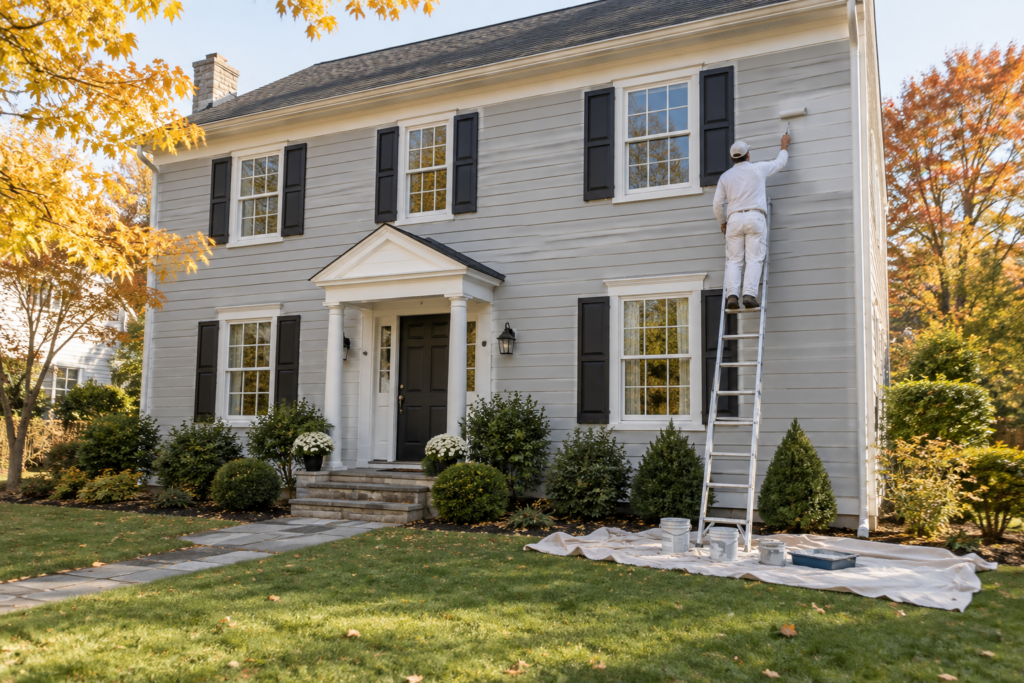
How Often Should You Paint Your House? A Repainting Timeline for Pennsylvania Homes
Most homes in southeastern Pennsylvania need exterior repainting every 5 to 10 years, and interior walls every 5 to 10 years depending on the room. The spread is that wide because material matters more than time: wood siding and trim typically need repainting every 4–7 years, stucco 5–8, aluminium siding 5–10, and brick 15–20. Interior ceilings can go a decade or more while a hallway or kids’ bedroom may need refreshing in three.
Time is the wrong way to decide, though. Your house tells you when it’s due, and it starts telling you a year or two before the paint actually fails. This guide covers how long each surface really lasts in our climate, the seven warning signs to look for, the best time of year to paint in Pennsylvania, and how to inspect your own home in about twenty minutes.
How long exterior paint lasts, by surface
These are typical service lives for a properly prepped, quality two-coat job in the mid-Atlantic climate. A poorly prepped job can fail in two years regardless of what’s on the can.
Surface | Typical repaint interval | What shortens it |
|---|---|---|
Wood siding and clapboard | 4–7 years | South and west exposure, moisture, missed caulk lines |
Wood trim, fascia, soffits | 3–5 years | Standing water, ice damming, direct sun |
Stucco | 5–8 years | Hairline cracking, rising damp at the base |
Aluminium siding | 5–10 years | Chalking, oxidation from UV |
Fibre cement (HardiePlank) | 10–15 years | Rarely the paint — usually the caulk fails first |
Brick (painted) | 15–20 years | Trapped moisture, efflorescence, previous coatings |
Vinyl siding (painted) | 5–8 years | Heat build-up on dark colours, expansion cracking |
Decks and railings (stain) | 2–3 years | Foot traffic, standing water, full sun |
Front door | 3–5 years | Sun and hand contact |
Two things drive most of the variation. Exposure: the south and west faces of a house take far more UV than the north side, and it is completely normal for one elevation to fail years before the others. Prep: paint fails at the surface it’s stuck to, not in the film. Scraping, sanding, priming bare wood and re-caulking joints is the difference between a job that lasts three years and one that lasts eight.
How often to repaint inside, room by room
Interior paint doesn’t weather — it wears. So the interval follows traffic and moisture, not the calendar.
Room | Typical repaint interval | Why |
|---|---|---|
Hallways, stairways, entry | 2–4 years | Highest contact and scuffing in the house |
Kitchen | 3–5 years | Grease, steam, frequent cleaning |
Bathrooms | 3–5 years | Humidity, mildew risk at ceiling line |
Children’s bedrooms | 3–5 years | Marks, cleaning, changing needs |
Living and dining rooms | 5–7 years | Moderate traffic, mostly colour fatigue |
Adult bedrooms | 6–10 years | Low traffic |
Ceilings | 8–10+ years | Rarely touched — but repaint if you smell smoke or see water staining |
Trim, doors, baseboards | 4–6 years | Contact wear; usually chipped before walls look tired |
If you’re repainting a whole floor, do trim and walls in the same visit. Trim is where the labour is, and coming back to it in two years costs more than doing it once with the walls.
Seven signs your house needs painting now
Waiting until paint peels means paying for repairs as well as paint. These are the signs that show up first, roughly in the order they appear:
- Chalking — a fine powder on your hand when you rub the siding. The binder has broken down under UV; the coating is at the end of its life but the substrate is still sound. This is the ideal time to repaint.
- Fading, especially unevenly — the south and west walls looking noticeably lighter than the north side.
- Hairline cracking or “alligatoring” — a scaly pattern in the paint film, usually from too many coats or a compatibility problem underneath.
- Caulk failure — gaps opening at window and door joints, or caulk you can pick out with a fingernail. This lets water behind the paint, which is how peeling starts.
- Peeling or blistering — the coating has lost adhesion. Now you’re in repair territory, not maintenance.
- Bare or grey wood — exposed wood weathers grey within months and will not hold a topcoat without sanding and priming. Left another season it starts to rot.
- Mildew or dark streaks — common on shaded north-facing walls and under gutters. Sometimes it washes off; if it comes back within weeks, the coating has lost its mildewcide.
The rule of thumb: chalking and fading mean plan it. Caulk failure and peeling mean do it this season. Bare wood means do it now, because the next cost is carpentry.
How to inspect your own house in 20 minutes
Do this once a year, ideally in spring. You need nothing but daylight and a fingernail.
- Walk the perimeter in daylight, one elevation at a time. Note which faces look worst — you’re checking whether the failure is on one exposure or all four.
- Rub your palm on the siding of the sunniest wall. Chalky residue means the coating is spent.
- Check every caulk joint at windows, doors and corner boards. Press with a fingernail. Hard, cracked or missing caulk is your first real repair item.
- Look up at trim, fascia and soffits. These fail years before the siding does, and they’re where water gets in.
- Inspect the bottom 18 inches of walls and any surface near a deck, gutter or downspout. Splash-back and standing water do the most damage.
- Check inside on the same day — ceiling corners in bathrooms, walls under windows, and any stain that’s appeared since last year. Interior stains usually mean an exterior problem.
If items 3, 4 or 5 turn up problems, get a contractor to look before you plan a colour. The repair scope, not the paint, will drive the timeline and the price.
The best time to paint a house in Pennsylvania
Our season runs roughly from late April through mid-October, and the two shoulder ends are the best of it.
- Late spring (May–June) — mild temperatures, lower humidity than midsummer, and dry surfaces after the spring rains have passed.
- Early autumn (September–early October) — usually the single best window in our area. Humidity has dropped, days are still warm, and the wood has dried out over summer.
- Midsummer (July–August) — workable but not ideal. Direct sun on a wall in the high 80s makes paint flash off too fast, which can leave lap marks and weaken adhesion. Good crews follow the shade around the house through the day.
- Late autumn and winter — most exterior coatings need surface and air temperatures above about 50°F, with some low-temp products rated to 35°F, and they need those temperatures to hold overnight while the film cures. Once October ends, that’s not reliable here.
Interior painting has no season. Winter is genuinely a good time to do it — crews have more availability, and modern low-VOC paints make it comfortable to be in the house while the work happens.
One practical note about scheduling: good painting contractors in Bucks County are booked weeks out in the spring and autumn peaks. If you want an autumn exterior job, ask for the quote in July. If you want the first fine weather in spring, ask in February.
What actually makes a paint job last
The lifespans in the table above assume things that are easy to skip:
Step | Why it decides the lifespan |
|---|---|
Wash and scrape | Paint bonds to a clean, sound surface — nothing sticks to chalk or dirt |
Sand bare and glossy areas | Gives the primer something mechanical to grip |
Prime bare wood and repairs | Bare wood swells and moves; unprimed patches are the first to peel |
Re-caulk joints | Keeps water out from behind the film, which is the main cause of premature failure |
Two full coats | One coat gives you colour, not protection or film thickness |
Right conditions | Not on wet surfaces, not in direct blazing sun, not below the product’s minimum temperature |
Ask any contractor to write these into the quote as line items. A number without a prep spec isn’t comparable to another number with one.
When repainting isn’t the right answer
Sometimes paint is the wrong purchase:
- Rotten wood needs replacing first — paint over soft wood and it fails within a year while the rot continues underneath.
- Repeated peeling in one spot after a proper repaint usually means moisture is getting in from somewhere else: gutters, flashing, a failed seal.
- Painting brick that has never been painted is a permanent decision. It traps moisture, and stripping it later is expensive and messy. Worth a long conversation before you commit.
- Failing vinyl or aluminium siding may be better replaced than coated if it’s cracked or brittle.
A contractor who tells you this before quoting is telling you something useful about how they work.
Where New Look Painting & Remodeling works
New Look Painting & Remodeling is based at 37 Cobalt Ridge Dr N, Levittown, PA 19057, and works across Bucks and Montgomery Counties — Levittown, Newtown, Yardley, Langhorne, Bensalem, Richboro, Southampton, Holland, Warminster, Warrington, Doylestown, New Hope, Washington Crossing and Willow Grove. You can see the full service area and recent project photos on the site.
Because we handle both interior painting and exterior painting as well as drywall repair, the prep work most houses need can be done by one crew rather than coordinated between trades. Estimates are done on site, in person, and written down before any work is scheduled — request one here or call (267) 980-1476.
If your inspection turned up peeling, bare wood or failed caulk, the useful next step isn’t picking a colour — it’s getting the repair scope assessed. Our guide to choosing exterior paint colours for a Bucks County home is the step after that one.
Frequently asked questions
How often should you paint your house?
Exteriors in southeastern Pennsylvania typically need repainting every 5 to 10 years, and interiors every 5 to 10 years depending on the room. Wood siding and trim are at the short end at 3 to 7 years; brick and fibre cement can go 15 years or more. Condition matters more than the calendar — chalking, fading and failed caulk mean it’s time regardless of the date of the last job.
How long does exterior paint last?
A properly prepped two-coat job on wood siding usually lasts 4 to 7 years, stucco 5 to 8, aluminium siding 5 to 10 and painted brick 15 to 20. Trim, fascia and soffits fail first, often within 3 to 5 years. Prep quality and sun exposure change these numbers more than the brand of paint does.
How do I know if my house needs painting?
Look for seven signs, in this order of urgency: chalky residue on your hand, uneven fading, hairline cracking, cracked or missing caulk at joints, peeling or blistering, exposed grey wood, and mildew streaks that return after washing. Chalking and fading mean plan the job; failed caulk or peeling means do it this season.
What is the best time of year to paint a house exterior in Pennsylvania?
Late April through mid-October, with early autumn — September into the first days of October — usually the best window in our area because humidity has dropped and surfaces are dry. Late spring is the second-best. Book several weeks ahead, since spring and autumn are when contractors are busiest.
What temperature is too cold to paint outside?
Most exterior coatings need surface and air temperatures above roughly 50°F, and some low-temperature products are rated down to about 35°F. The temperature has to hold overnight while the film cures, not just in the afternoon, which is why exterior work generally stops here at the end of October.
Can you paint a house in the fall?
Yes — early autumn is often the ideal time in Bucks County. Humidity is lower than in midsummer, wood has dried out over the season, and daytime temperatures are still well within range. The limit is daylight and overnight temperatures, so the window closes fairly quickly through October.
How often should you paint interior walls?
Hallways and entryways every 2 to 4 years, kitchens and bathrooms 3 to 5, living and dining rooms 5 to 7, adult bedrooms 6 to 10, and ceilings 8 to 10 or more. Interior paint wears rather than weathers, so traffic and moisture set the interval.
Does one coat of paint ever count as a repaint?
Only for a colour touch-up on a sound surface. One coat provides colour but not film thickness, which is what actually protects the substrate — so a single coat on an exterior will typically fail years earlier than a proper two-coat job.
Why is my paint peeling only a few years after being painted?
Almost always a prep or moisture issue rather than a paint defect: painting over chalky or dirty siding, skipping primer on bare wood, painting a damp surface, or water entering behind the film through failed caulk, gutters or flashing. Repainting without fixing the water source repeats the failure.
Should I paint or replace my siding?
If the siding is sound and only the coating has failed, painting is far less disruptive and expensive. If wood is rotten, or vinyl and aluminium are cracked, brittle or badly warped, replacement is the better spend — paint over failing material buys a season or two at most.
Is it worth painting brick?
Sometimes, but treat it as permanent. Painted brick traps moisture, needs a breathable coating and correct preparation, and stripping it later is expensive. Painted brick that’s done properly can go 15 to 20 years, so the question is whether you want it painted for that long.
How long does it take to paint a house?
An average interior repaint of a few rooms usually takes two to four working days; a whole-house interior a week or more. Exteriors typically run three to seven days depending on size, how much scraping, sanding and carpentry is needed, and the weather. Prep is usually more than half the labour.
Do you paint in the winter?
Interiors, yes — winter is a good time for interior work, with better availability and low-VOC paints that make the house comfortable to live in while it’s happening. Exterior painting waits for reliable temperatures, generally from late April.
How do I compare painting quotes properly?
Ask each contractor to itemise prep: washing, scraping, sanding, priming bare wood, re-caulking, and how many coats. Ask which products they’re using and how much surface repair is included. Two quotes are only comparable when the prep scope is written down, which is also why an on-site estimate beats a number given over the phone.
