
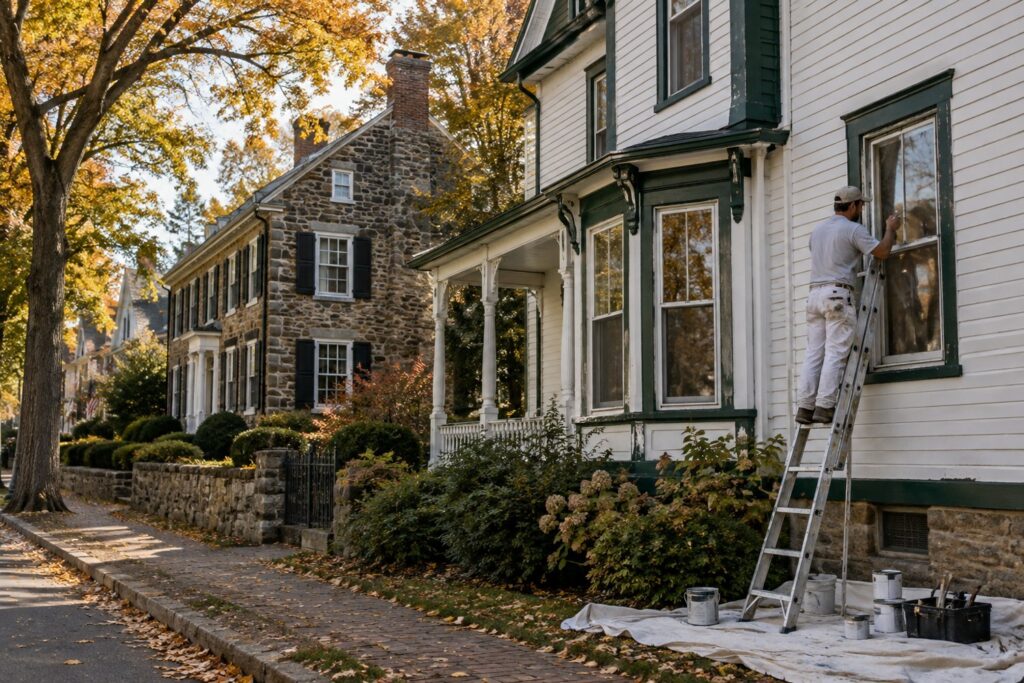
House Painters in Bucks County, PA: What Older Homes in Each Town Need
Short answer: Good house painters in Bucks County, PA start by asking how old your home is. Most houses here were built before 1978, so the job usually involves lead-safe prep, many layers of old paint, and wood or masonry that needs more care than new vinyl. What that means changes by town: a 1950s Levittown rancher, a Victorian on Washington Avenue in Newtown and a stone house on Radcliffe Street in Bristol each need a different plan. This guide walks through the six towns we work in most and what to ask for in each.
Bucks County has been settled since the late 1600s, and you can still see every era of it from the road. That’s part of what makes it a great place to live. It also means two painting quotes for two houses a mile apart can, and should, look very different. Below we explain why house age matters, then go town by town.
Why house age matters more than square footage
When homeowners call us, the first questions are usually about size and color. For an older Bucks County home, three other things decide how long the paint lasts and how the job should be done.
1. Lead paint in homes built before 1978
Lead paint was banned for homes in 1978. If your house is older than that, some of the layers under today’s paint may contain lead. The EPA’s Renovation, Repair and Painting (RRP) Rule applies to paid work that disturbs paint in pre-1978 homes: the firm must be EPA-certified and follow lead-safe work practices, unless the paint has been tested and shown to be lead-free.
Small jobs are exempt: six square feet or less of paint per room inside, or 20 square feet or less outside. Scraping and sanding a whole exterior, or a full set of rooms, is almost always well over that. Before work starts, you should receive the EPA’s Renovate Right pamphlet.
2. Wood siding, trim and many old coats
Older homes have more real wood: clapboard, window sashes, porch columns, railings and cornices. Wood moves with the seasons, and every repaint adds another layer. After several decades, the paint film can get thick enough to crack and lift as one piece. Good prep means scraping back to a sound edge, sanding, repairing soft wood and spot-priming bare spots before any finish coat goes on.
3. Masonry, stucco and older siding materials
Many 18th- and 19th-century Bucks County homes are stone or stucco, and many mid-century homes have been covered with aluminum or other siding since. Each takes different prep and different paint. Stone and stucco need products that let moisture escape. Aluminum siding needs cleaning and the right acrylic primer. Older cement-based siding should never be dry-sanded or scraped hard; it’s washed and primed instead.
| What you have | What it usually needs | What to ask the painter |
|---|---|---|
| Pre-1978 paint anywhere | Lead-safe setup, containment and cleanup | “Are you EPA lead-safe certified, and how will you contain dust?” |
| Wood clapboard and trim | Scraping, sanding, wood repair, spot-priming | “How do you handle soft or rotted wood, and how is it priced?” |
| Stone or stucco | Breathable products, crack repair | “Which product will you use on masonry, and why?” |
| Aluminum siding | Washing, chalk removal, acrylic primer | “Will you test for chalking and prime first?” |
| Older cement-based siding | Gentle washing, no dry sanding, primer | “How will you prep this without sanding?” |
House painters in Bucks County, PA: town by town
We’re based in Levittown and work across the county. These are the six towns we’re asked about most, with the housing you’ll typically find in each and what that means for painting.
Levittown
Levitt and Sons built a little over 17,300 homes here between 1952 and 1958, in six basic models such as the Levittowner, Jubilee and Rancher. Levittown spreads across Bristol Township, Falls Township, Middletown Township and Tullytown Borough, so your township handles any permit questions.
What these homes need: almost every original Levittown house is pre-1978, so lead-safe prep is the starting point. Many have been expanded or re-sided over 70 years, which means one house can have original wood trim, newer vinyl and an addition with different materials. A good quote names each surface and how it’ll be prepped. If you’re comparing contractors, our guide on [hiring a painting contractor in Levittown, PA](https://newlookpainting-remodeling.com/hiring-painting-contractor-levittown-pa/) lists the questions to ask.
Bensalem
Bensalem Township was established in 1692, but most of its homes came later. Between 1950 and 1980 its population grew almost 500%, as large post-war neighborhoods filled the township. It has creeks and the Delaware River on three sides.
What these homes need: many Bensalem homes are from the 1950s to 1970s, so expect lead-safe rules to apply. Homes near the water and in shaded lots often show mildew and peeling on north-facing walls, so washing and a mildew treatment before painting matter. For outside work, see our page on [exterior painting in Bensalem](https://newlookpainting-remodeling.com/local-exterior-painting/bensalem/).
Langhorne
Langhorne Borough has a National Register historic district with 309 parcels, and its buildings range from the colonial era to the early 20th century: Federal, late Victorian and Craftsman bungalow styles among them.
What these homes need: detailed wood trim, porches and original siding that reward careful hand prep. If your home is in the historic district, exterior changes go through the borough’s Historic Architectural Review Board (HARB). Its residential guide says paint color choices can be submitted for a Certificate of Appropriateness and encourages historically appropriate colors, and it doesn’t allow vinyl or aluminum as replacement siding. Check with the borough before you pick colors or replace boards. See our pages for [exterior painting in Langhorne](https://newlookpainting-remodeling.com/local-exterior-painting/langhorne/) and [interior painting in Langhorne](https://newlookpainting-remodeling.com/local-interior-painting/interior-painting-in-langhorne/).
Newtown
Newtown was surveyed in 1683 to 1684 as part of William Penn’s town planning and was the county seat until 1813. Its historic district, shared by the borough and township, has about 230 historic buildings from the late 17th to early 20th century: 18th-century town houses around Court Street and large Victorian homes along Washington Avenue. Outside the district, much of Newtown Township is newer suburban housing.
What these homes need: Victorian homes in Newtown often have deep trim, brackets, porches and multiple colors, which means more brush work and more prep hours than a plain two-story. Older stone and stucco walls need breathable products. Newer homes in the township are mostly post-1978, so lead rules may not apply there; it’s one reason two Newtown quotes can differ so much. See [exterior painting in Newtown](https://newlookpainting-remodeling.com/local-exterior-painting/newtown/).
Yardley
Yardley grew from an early 18th-century mill and ferry crossing on the Delaware. The borough’s historic district has about 200 structures, and most are frame, two-and-a-half-story houses from the mid to late 1800s, with small stone houses along East Afton Avenue. Around the borough, Lower Makefield Township is mostly suburban homes built after World War II.
What these homes need: frame houses mean wood siding and trim, often with many coats of old paint. Being near the river and the canal means more moisture, so checking for soft wood at sills, porch floors and the bottom courses of siding is part of a proper estimate. See [exterior painting in Yardley](https://newlookpainting-remodeling.com/local-exterior-painting/yardley/).
Bristol
Bristol Borough’s historic district covers the original town laid out in 1697 along the Delaware River. It has more than 300 buildings, a few from the early 1700s, and most are homes, from closely spaced town houses to large riverfront houses on Radcliffe Street, some dating to around 1800.
What these homes need: a mix of brick, stone and frame houses with wood cornices and window trim, and tight lots where homes sit close together or share walls. Ladder access, protecting the neighbor’s property and lead-safe containment all need planning. River exposure also means more weathering on the water side. Ask how the crew will set up on a narrow lot before you sign.
Exterior prep older homes need
Whatever town you’re in, prep is what makes paint last on an older house. A full exterior on a Bucks County home built before 1978 usually includes:
1. Lead check and setup. Testing, or treating the paint as lead-containing, with ground covers, containment and daily cleanup.
2. Washing. Removing dirt, chalk and mildew so the new paint can bond.
3. Scraping and sanding. Taking loose paint back to a sound edge and feathering the edges so they don’t show through.
4. Wood repair. Replacing or repairing soft wood at sills, trim, fascia and porch parts.
5. Caulking and priming. Sealing open joints and priming any bare wood or repairs.
6. Two finish coats. With a paint made for the surface and the weather.
Our page on [exterior house painting services](https://newlookpainting-remodeling.com/exterior-house-painting-services/) explains each of these steps in more detail.
Interior vs exterior timing
In Bucks County, exterior painting is a warm-weather job. Most paints need air and surface temperatures to stay above their minimum for hours after painting, so our outside season generally ends around the end of October and picks up again in spring. Our post on [how cold is too cold to paint outside](https://newlookpainting-remodeling.com/exterior-home-painting-company-cold-weather/) explains the numbers.
Interior painting has no season. Late fall and winter are a good time to do rooms, hallways and trim, and to book your exterior quote so it’s ready for spring. If you’re doing both, ask for [interior painting](https://newlookpainting-remodeling.com/interior-painting/) and exterior in one plan so the colors work together.
How to choose house painters in Bucks County, PA
– Ask about the house first. A good painter asks when it was built, what the siding is and what’s been done before.
– Ask for lead-safe details in writing for any pre-1978 home.
– Compare prep line by line. If one quote lists washing, scraping, wood repair and priming and another just says “paint house,” they’re not the same job.
– Check local knowledge. Historic districts in Langhorne, Newtown, Yardley and Bristol have their own rules.
– Get a written quote. At New Look, after an on-site visit, we give you a printed quote that lists labor, materials, pricing and work specifications.
You can see the full list of towns we serve on our page for [house painters in Bucks County, PA](https://newlookpainting-remodeling.com/service-areas/).
Frequently asked questions
Do I need a lead-safe painter for my Bucks County home?
If your home was built before 1978 and the job will disturb more than six square feet of paint per room inside or 20 square feet outside, the EPA’s RRP Rule requires a certified firm using lead-safe practices, unless the paint has been tested and found lead-free.
Can I choose any paint color in a historic district?
It depends on the borough. In Langhorne’s historic district, the Historic Architectural Review Board reviews exterior work, and its residential guide says paint color choices can be submitted for approval. Check with your borough before you choose colors or replace siding or trim.
Why do older homes cost more to paint than newer ones?
Mostly because of prep. Older homes have more wood, more layers of paint, more detail and often lead-safe requirements. Those take more hours than painting a newer house the same size.
When is the best time to paint the outside of an older home in Bucks County?
Late spring to early fall, on dry days when the temperature stays above the paint’s minimum. Fall and winter are good times to get your quote and pick colors so the job can start when the weather turns.
What areas does New Look serve?
We’re based in Levittown and work across Bucks County, including Bensalem, Langhorne, Newtown, Yardley, Bristol, Doylestown, New Hope and more. [Get a free quote](https://newlookpainting-remodeling.com/get-free-quote/) and we’ll set up an on-site visit.
Ready to plan your project? Whether it’s a Levittown rancher or a Victorian in Newtown, we’ll look at the house, explain what it needs and give you a written quote. [Get your free quote](https://newlookpainting-remodeling.com/get-free-quote/) or call 267-980-1476.
